






1. Gartner says advanced messaging will overtake SMS by 2028
This isn't a startup's blog prediction. Gartner - one of the most conservative analyst firms in tech - projects that advanced messaging channels like RCS and WhatsApp will overtake SMS for customer service and support use cases by 2028.
That's two years from now.
If you're still building your messaging strategy around SMS, you're investing in a channel that analysts expect to become secondary.
2. RCS messages get 3-7x higher click-through rates than SMS
Let's talk about what matters most: do people actually engage? RCS consistently delivers 3-7x higher click-through rates compared to SMS. That's not a marginal improvement - it's a fundamentally different level of engagement.
The reason is simple: RCS messages can include carousels, rich cards, suggested actions, and embedded buttons.
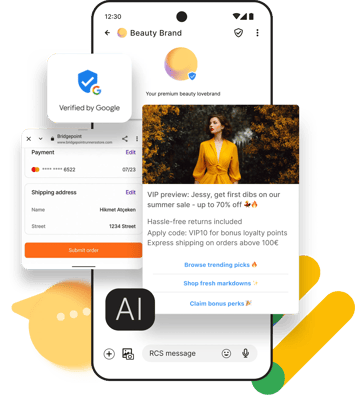
Instead of sending a text that says "Check out our new collection" with a URL, you can show product images, prices, and a "Shop now" button right inside the message.
Source: Sinch RCS Benchmarks
3. 68% of your customers already engage via smartphone - across all age groups
A common objection to RCS: "Our customers are older, they won't use it." The data says otherwise. 68% of customers - including baby boomers and Gen X - now engage with brands via their smartphones. RCS doesn't require downloading an app or signing up for a new platform. It works in the messaging app that's already on their phone.
Source: Gartner / 2025 State of the Customer Survey
4. AI + messaging = 50% more engagement (by 2029)
Gartner predicts that organizations leveraging advanced AI within messaging channels will see 50% more customer engagement and ROI by 2029. This is the part most providers miss: RCS alone is an upgrade, but RCS combined with AI-powered conversational flows is a completely different product.
Think product finders that guide customers through questions and recommend the right item. Think automated appointment booking that handles back-and-forth scheduling. Think lead qualification flows that ask the right questions and route hot leads to your sales team - all inside a native messaging thread.
Source: Gartner, "WhatsApp vs. RCS vs. SMS," January 2026
5. Only 23% of brands do proactive outreach - the rest are leaving money on the table
Here's a stat that should make every marketing leader uncomfortable: only 23% of customer interactions involve proactive outreach from brands. That means 77% of the time, brands are waiting for customers to come to them.
RCS changes this equation. With verified sender profiles (so customers know it's really you), rich media, and interactive elements, you can proactively reach customers with messages that actually feel valuable - not spammy. Product launches, restock alerts, personalized recommendations, appointment reminders - all delivered in a format that invites a response.
Source: Gartner, "WhatsApp vs. RCS vs. SMS," January 2026
6. RCS traffic grew 550% in a single year
This isn't gradual adoption. RCS business messaging traffic grew by 550% in 2024 alone, following a 358% increase in 2023. With Apple supporting RCS since iOS 18, the reach is now effectively universal on modern smartphones.
The infrastructure discussion is over. The carriers are on board. Google and Apple both support it. The only question left is whether your brand will use it.
Source: Infobip Messaging Trends Report 2025
7. 73% of customer journeys span multiple channels
Your customers don't live in one channel. 73% of customer service journeys now involve multiple company-owned channels. They might discover you on Instagram, ask a question via RCS, and complete a purchase on your website.
This is why your RCS provider needs to integrate with your existing stack - CRM, e-commerce platform, helpdesk, and other messaging channels. An RCS tool that lives in a silo creates fragmented customer experiences.
Source: Gartner / 2025 State of the Customer Survey
8. Messaging resolves issues faster than voice
Messaging apps achieve 58% resolution rates for customer service - outperforming traditional phone support. And when you add AI-driven conversational automation on top, the numbers improve further: common questions get answered instantly, complex issues get routed to the right agent with full context, and customers don't have to repeat themselves.
RCS makes this even more powerful than WhatsApp or webchat because it's the native messaging channel. No app download, no QR code scan, no login required. The customer just replies.
Source: Gartner, "WhatsApp vs. RCS vs. SMS," January 2026
9. Gartner explicitly recommends integrating GenAI into messaging channels
This isn't a fringe opinion. Gartner now explicitly recommends that organizations integrate generative AI into their RCS and WhatsApp channels as a strategic priority. The analyst firm sees AI-powered messaging as the future of customer engagement - not a nice-to-have, but a core capability.
For brands, this means the RCS provider you choose matters more than you might think. A provider that treats RCS as a broadcast channel won't help you capture this opportunity. You need a partner with real AI depth - intent recognition, personalized product recommendations, automated conversational flows, and seamless human handoff when needed.
Source: Gartner, "WhatsApp vs. RCS vs. SMS," January 2026
RCS vs. SMS vs. WhatsApp: A Quick Comparison
How does RCS stack up against the channels you already know? Here's a side-by-side overview:
| SMS | RCS | WhatsApp Business | |
|---|---|---|---|
| Rich media | No (text + links only) | Yes (carousels, cards, buttons, images) | Yes (images, buttons, lists) |
| App download required | No | No (native messaging app) | Yes (WhatsApp must be installed) |
| Verified sender | No (spoofing is common) | Yes (branded profile with logo) | Yes (green checkmark for verified accounts) |
| Two-way conversations | Limited (manual replies only) | Yes (automated conversational flows) | Yes (automated conversational flows) |
| Reach | Universal (every phone) | 1.5+ billion active users globally, projected to reach 3.8 billion by end of 2026. In Germany alone, 80%+ of smartphone users are RCS-eligible. | 3.1 billion monthly active users globally. 94%+ penetration in the DACH region (~75-78M users). |
| Fallback | N/A | Not automatic - your provider can enable fallback to SMS or WhatsApp depending on your setup | Requires WhatsApp installation |
| GDPR opt-in | Required | Required | Required |
| Best for | Transactional alerts, OTPs | Marketing campaigns, conversational commerce, customer service | Ongoing customer relationships, support, community building |
The takeaway: RCS combines the native reach of SMS (no app download) with the rich, interactive capabilities of WhatsApp. With projected reach of 3.8 billion users by the end of 2026, RCS is on track to match WhatsApp's global footprint - while working natively on every modern smartphone without requiring an app install. For brands operating in markets like Germany, where 80%+ of smartphone users are already RCS-eligible, the channel is ready now.
How to Get Started with RCS
Convinced by the numbers? Here's what the first steps actually look like:
1. Choose a provider that matches your ambition. If you just want to send broadcast campaigns, most providers will do. If you want two-way conversational flows with AI, product integration, and real personalization, your shortlist gets much shorter. (We put together a detailed RCS provider comparison if you want to dig deeper.)
2. Register as a verified RCS sender. Your brand gets a verified profile with your logo, brand colors, and company name - so customers know it's really you. This is handled through Google's RCS Business Messaging program, typically via your RCS provider.
3. Design your first conversational flow. Don't start with a mass blast. Start with one use case - a product finder, appointment booking, or lead qualification flow - and build a proper conversation around it. This is where the real ROI lives.
4. Test, measure, iterate. Run A/B tests against your existing SMS campaigns. Track click-through rates, response rates, and conversions. The data will make the case for scaling RCS internally.
Ready to explore what RCS can do for your brand?
The data is clear: RCS is not "SMS 2.0" - it's a fundamentally different channel with fundamentally better results. But only if you use it right.
At charles, we've spent years building conversational marketing expertise on WhatsApp as an official Meta Business Partner - and now we're bringing that same depth to RCS as an official Google RCS Partner. Our team doesn't just give you a tool. We help you design the conversations, build the AI flows, and optimize your campaigns for real business outcomes.
Whether you're in e-commerce, insurance, automotive, travel, or any industry with complex products - we'd love to show you what two-way RCS conversations can look like for your business.
Looking for a detailed platform comparison? Check out our RCS Provider Comparison to see how European providers stack up.
charles is an AI-native platform for conversational marketing and commerce. We help consumer brands automate, personalise, and monetise customer conversations across WhatsApp or RCS. Official Meta Partner and verified Google RCS partner. Made in Berlin.