Back

RCS Marketing Software Comparison 2026

By Michel Behling

Growth Marketing Lead, charles

RCS is finally mainstream-ready. With Apple's iOS 18 adoption complete and Google pushing hard to establish RCS as the new standard, brands are moving fast. But here's the problem: most providers treat RCS like "fancy SMS" - one-way blasts with prettier pictures. The real opportunity lies in two-way conversational automation. And that's where the provider landscape splits.
This guide compares RCS marketing platforms active in Europe - software for building campaigns, automating conversations, and integrating AI. Not carrier infrastructure. 
 

What Separates Good from Great

  • True two-way automation - Not just "click a button, trigger a message." Real conversational flows that handle back-and-forth dialogue.
  • AI/chatbot depth - Intent recognition, personalized responses, human handoff.
  • Channel expertise - Has the team actually mastered conversational commerce, or did they bolt RCS onto an SMS platform?
  • Commerce & enterprise integration - Deep ties to Shopify, CRMs, and CDPs for personalized journeys - plus support for complex enterprise use cases.

Platform Comparison

1. charles
Best for: Brands that want to use RCS as a true conversational channel, not just a broadcast tool

c1

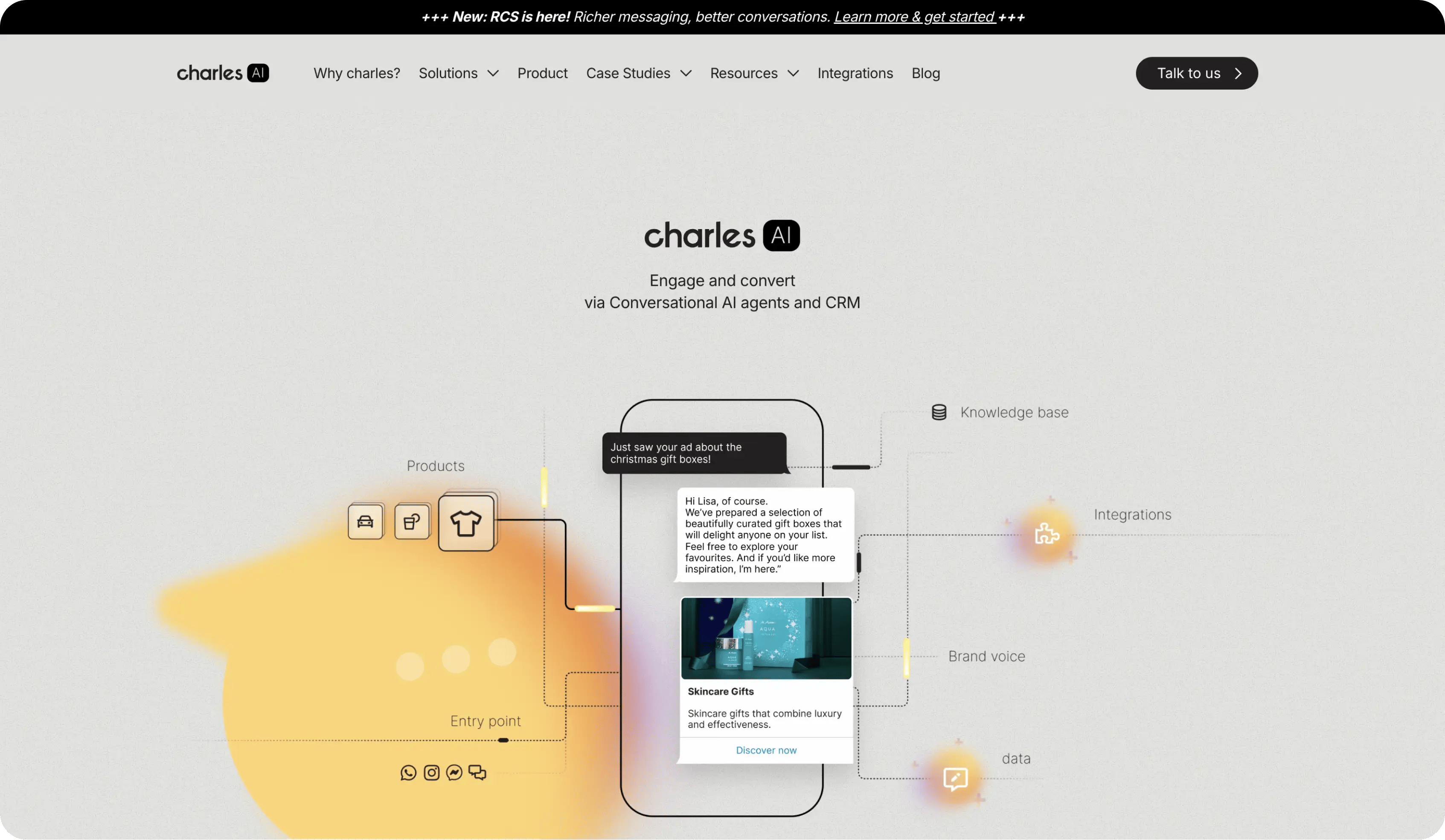
charles comes from a different lineage than most RCS providers. Founded in Berlin by the co-founder of Kapten & Son and an ex-McKinsey e-commerce lead, charles built our reputation as a leading WhatsApp marketing platform before expanding to RCS.

The difference shows.

While most providers bolted RCS onto existing SMS infrastructure, charles approaches it as a conversational channel first - because that's what we've been doing with WhatsApp for years: Building two-way conversations that actually drive revenue. Those learnings from WhatsApp - across thousands of campaigns and many industries - now flow directly into our RCS product.

Why charles stands out:
  • True two-way expertise - Most providers talk about "conversational messaging" but deliver glorified autoresponders. charles built automated conversational flows that handle product finders, customer support requests, guided selling, appointment booking, and lead qualification. This isn't "if customer clicks X, send Y." It's actual back-and-forth dialogue.
  • Google RCS Partner - Official Google partner for RCS. As their Google Germany RCS lead put it: charles is a trusted partner they work closely with on bringing RCS to market.
  • Commerce & enterprise integrations - Native connections to Shopify, Klaviyo, Emarsys, Zendesk & more possible. Your RCS flows pull real product data, cart information, and customer history.
  • Flexible fallback options - With deep WhatsApp expertise, charles can offer SMS or WhatsApp fallbacks based on customer preference and use case requirements if needed.
  • In-house agency support - charles doesn't just provide software. Our conversational design experts help brands with strategy, flow design, and campaign preparation - so you're not alone navigating a new channel.
  • Dedicated AI team & data feed optimization - AI agents are only as good as the data and setup behind them. charles has a dedicated AI team that continuously improves and updates its AI capabilities, and actively supports brands with product feed optimization, data structuring, and agent configuration. Because building a great RCS flow is one thing - making sure it always has accurate, well-structured product and customer data to work with is what actually drives results.
Did you know? charles created the world's first WhatsApp game - together with WWF. The campaign was so successful that in 2026, we teamed up again to launch WWF Gotchies, a second interactive experience built on the same conversational foundation. It's a good example of what happens when brands stop treating messaging as a broadcast channel and start treating it as a place where real engagement can happen.

Ideal Use Cases:

  • D2C fashion brands running product finders via RCS
  • Insurance companies using AI-powered lead qualification
  • Automotive brands handling test drive booking and customer inquiries
  • Travel companies automating booking confirmations and itinerary updates
  • Brands with complex products needing guided selling or appointment scheduling
  • Google Search Ads combined with automated RCS chats - bringing high-intent users from paid search directly into AI-powered conversations instead of static landing pages


2. Braze
Best for: Large enterprises that need RCS as one channel among many in cross-channel marketing workflows

c3

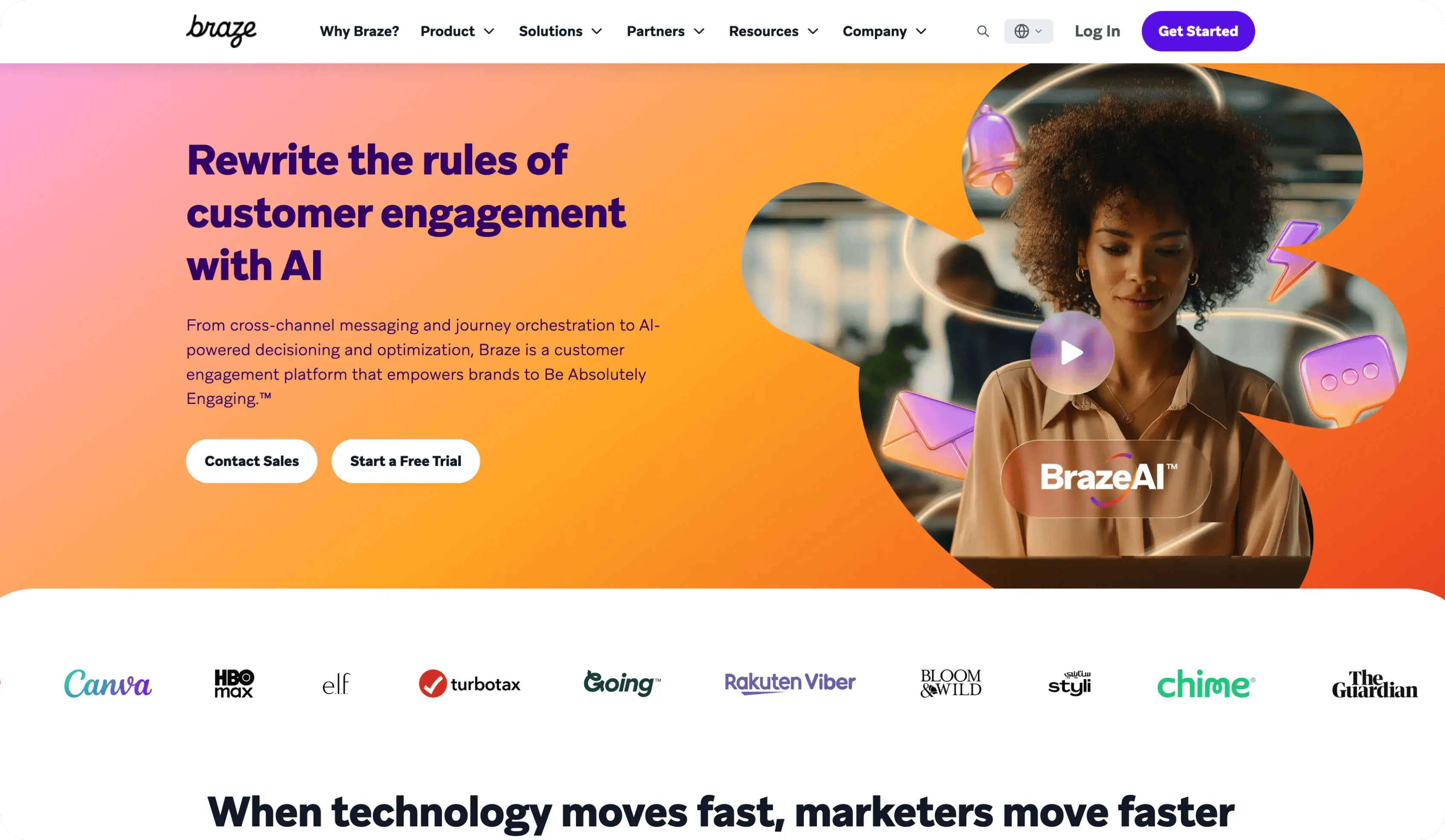
Braze was founded in 2011 in New York under the name Appboy, before rebranding in 2017. The company went public on NASDAQ in 2021 and has since grown to around 1,700 employees. Braze serves large enterprise clients like Burger King, HBO, and Domino's and is known for its cross-channel marketing orchestration.

At a glance:
  • Headquartered in New York with offices in the US, UK, Germany, Japan, and Singapore
  • Cross-channel platform covering email, push, SMS, in-app, and RCS
  • AI capabilities (branded "Sage AI") focused on channel orchestration and send-time optimization
  • Prominently positioned for enterprise marketing teams managing multiple channels
  • RCS is one of many supported channels rather than a core focus

For brands already using Braze for email or push, adding RCS to existing workflows seems relatively simple. The platform's strength is in deciding which channel to use and when - less so in building deep, two-way RCS conversations.

Best suited for:
  • Enterprise marketing teams already in the Braze ecosystem (make sure to compare capabilities)
  • Brands prioritizing cross-channel orchestration over conversational depth
  • Large-scale campaign management across many channels simultaneously


3. CM.com
Best for: Western European enterprises that need a broad communications platform beyond just messaging

c4

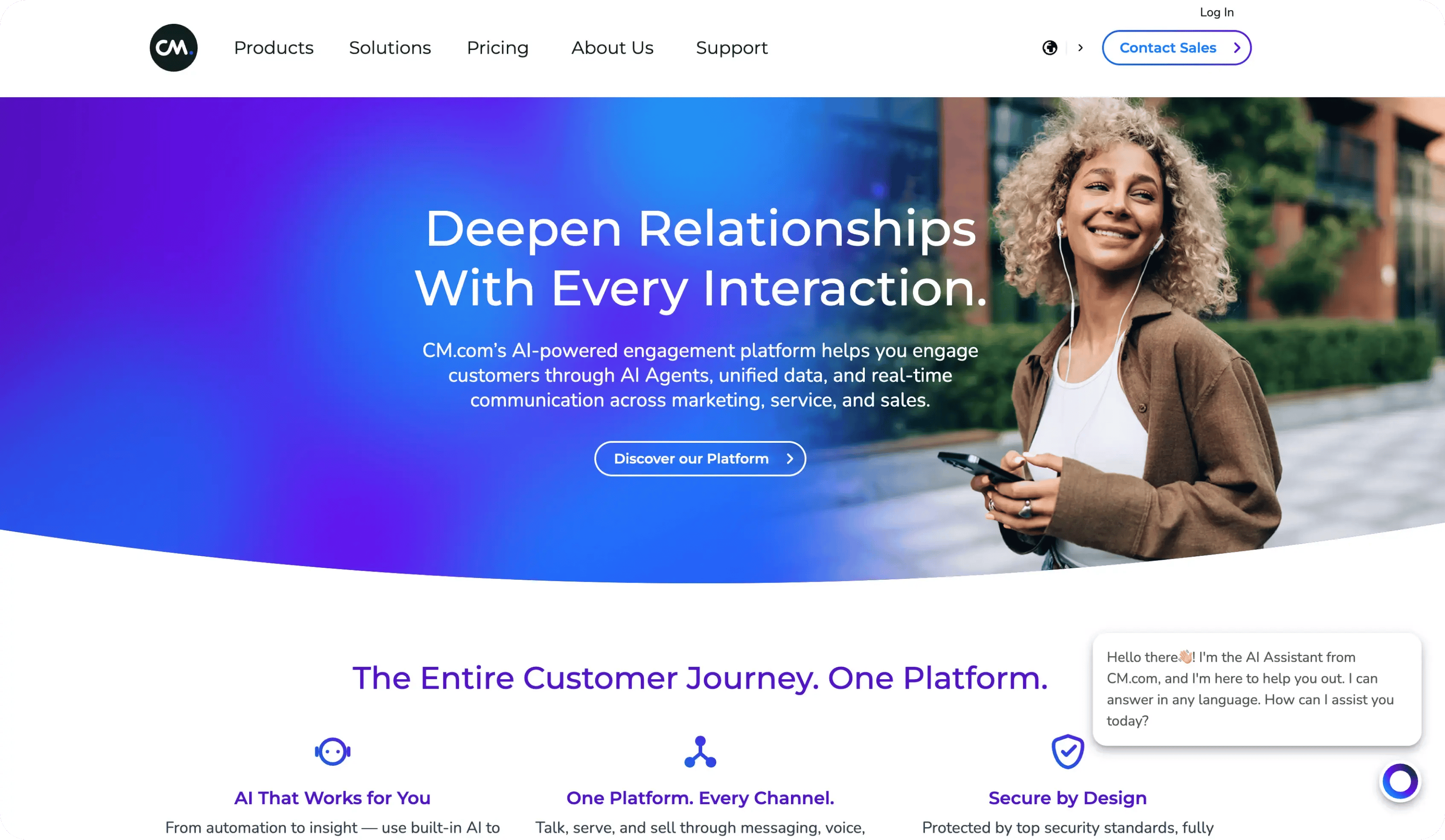
CM.com started in 1999 in Breda, the Netherlands, originally as ClubMessage - a service that sent SMS messages to club and bar visitors. Founders Jeroen van Glabbeek and Gilbert Gooijers built the company from SMS marketing for nightclubs to a publicly listed cloud communications company with over 750 employees.

At a glance:
  • Headquartered in the Netherlands with offices across Europe, Asia, and the US
  • Broad product range beyond messaging: ticketing, payments, and identity verification
  • Prominently features chatbot-building tools and omnichannel marketing on their website
  • Strongest presence in Western Europe (Germany, France, Spain, UK, Netherlands)

CM.com covers a wide range of communication channels and has expanded its business well beyond messaging into areas like event ticketing and mobile payments. Their RCS approach tends to lean more toward campaign broadcasting and transactional messaging than interactive, two-way conversational commerce.

Best suited for:
  • Larger enterprises in Western Europe looking for a broad communications platform
  • Brands that also need ticketing or payment functionality from the same provider
  • Companies looking for one of the more established European RCS options


4. Sinch
Best for: Developer teams and global enterprises that prioritize API infrastructure over out-of-the-box campaign tools

c6

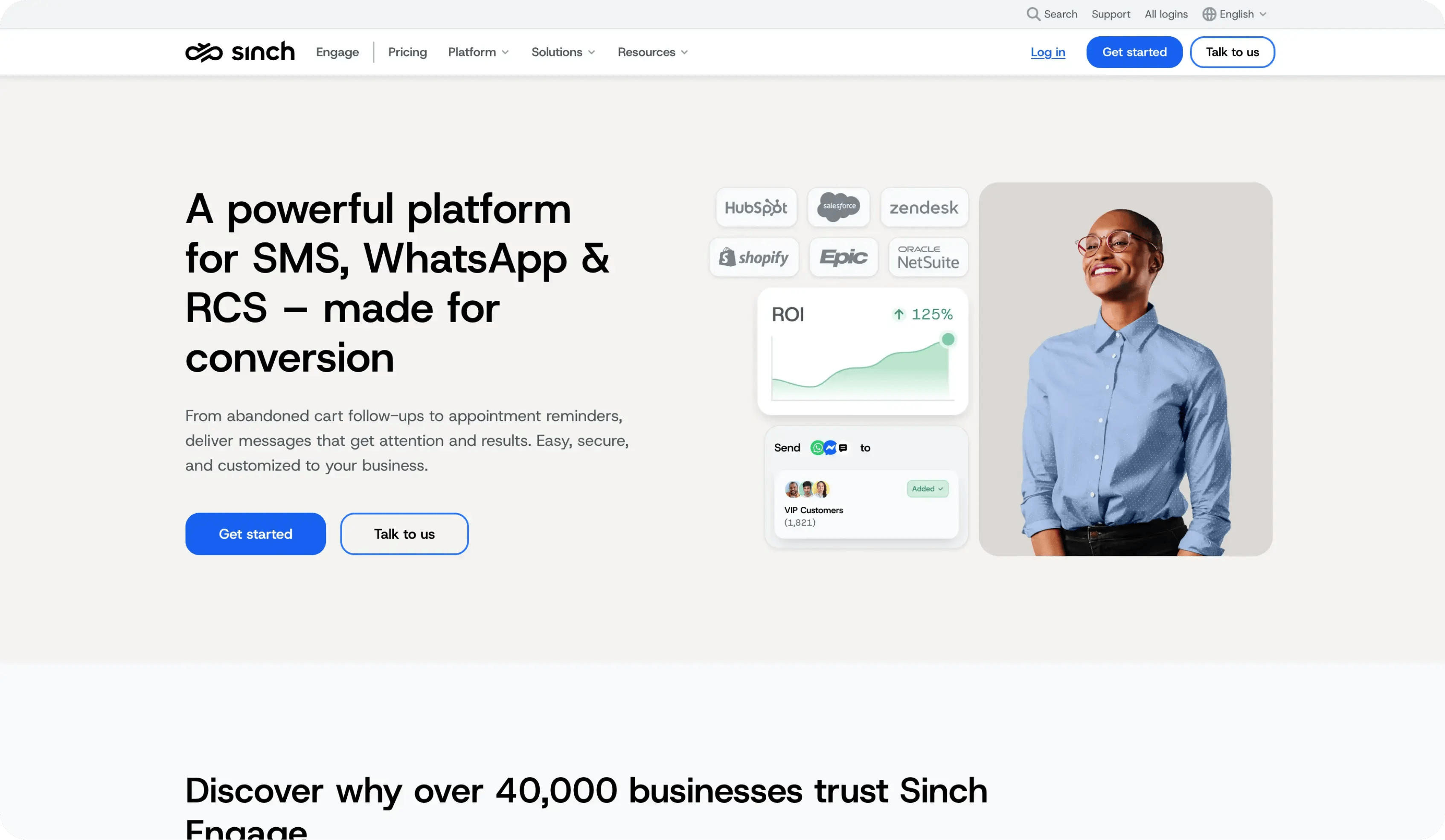
Sinch AB was originally founded in 2008 in Stockholm, Sweden, as CLX Communications before rebranding in 2019. The company is publicly listed on Nasdaq Stockholm and employs over 4,000 people across more than 60 countries. Sinch has grown aggressively through acquisitions, spending several billion dollars between 2021 and 2022 alone.

Notably for the German market, Sinch acquired the Munich-based company MessengerPeople in 2021 for EUR 48 million and rebranded it as Sinch Engage. MessengerPeople was originally a SaaS platform for conversational messaging via WhatsApp and Telegram, primarily serving SMBs in the DACH region.

At a glance:
  • Headquartered in Stockholm with presence in 60+ countries
  • Growth-through-acquisition strategy (Inteliquent, MessageMedia, Pathwire, MessengerPeople)
  • Developer-oriented DNA with a strong focus on APIs and infrastructure
  • Sinch Engage (formerly MessengerPeople) serves as the more accessible, non-technical entry point
  • Covers SMS, voice, email, and messaging channels under one roof

Sinch's platform is broad and infrastructure-heavy. Their RCS offering fits into this wider play. Sinch Engage provides a friendlier entry point for marketing teams, though the company's overall DNA remains more technical and API-focused than conversational commerce-focused.

Best suited for:
  • Developer teams that want API-first flexibility across many channels
  • SMBs in DACH already familiar with the former MessengerPeople platform
  • Enterprises looking for a large-scale infrastructure provider that also covers RCS


5. Telesign
Best for: Security-focused use cases like OTPs, fraud alerts, and identity verification

c7

Telesign was founded in 2005 in Los Angeles and was acquired by Belgian telecom group Proximus in 2017 for $230 million. In early 2025, Proximus merged Telesign with Route Mobile and BICS into a combined entity called Proximus Global, positioning it as a global digital communications player.

At a glance:
  • Originally a US company, now part of Belgium-based Proximus Global
  • Heritage in identity verification and fraud prevention - verifies over five billion phone numbers per month
  • RCS offering is an extension of their security-first product suite
  • Prominently features OTP delivery, phone number validation, and SIM swap detection on their website
  • Global reach with a focus on security and compliance use cases

Telesign's RCS capabilities are built on top of a security and verification platform rather than a marketing platform. Their AI capabilities are geared more toward fraud detection than towards guided selling or customer engagement flows.

Best suited for:
  • Companies prioritizing security-focused messaging (OTPs, fraud alerts, identity verification)
  • Enterprises in finance or healthcare that need compliance-driven communication
  • Brands looking for transactional RCS rather than marketing-driven campaigns


6. LINK Mobility (Websms)
Best for: DACH businesses looking to add RCS to an existing traditional SMS setup

c2

LINK Mobility was founded in 2001 in Norway and has since grown into one of Europe's larger CPaaS providers through a long series of acquisitions. The company is listed on the Oslo Stock Exchange and operates across 18 countries with 28 offices.

For the DACH region specifically, LINK Mobility acquired the Austrian company Websms in 2020 for EUR 53.8 million. Websms was established in 1999 in Graz and had built a strong position in Austria, Germany, and Switzerland over two decades. After the acquisition, Websms and SimpleSMS were merged under LINK Mobility Austria in 2021. 

At a glance:
  • Headquartered in Norway, strongest presence in Austria, Germany, and Switzerland
  • Websms brand has been active in the DACH region since 1999
  • Core business has been SMS for over 20 years, with WhatsApp and RCS added more recently
  • Around 6,200 business customers in the DACH region
  • Prominently features straightforward campaign delivery and traditional messaging services

LINK Mobility's approach is rooted in traditional mobile messaging. They've since added WhatsApp and RCS to their portfolio, which makes them a solid option for straightforward campaign delivery. Their platform is less focused on AI-driven conversational flows or innovative two-way automation.

Best suited for:

  • Businesses in Austria, Germany, or Switzerland looking for a local messaging provider
  • Brands that want to add RCS to an existing SMS setup with minimal change
  • Companies focused on transactional messaging and straightforward campaign delivery


RCS in Numbers: Benchmarks & Industry Data

RCS consistently outperforms SMS and traditional channels:


Gartner predicts that by 2028, advanced messaging channels like RCS and WhatsApp will overtake SMS for customer service use cases. The shift isn't coming - it's already underway.

Source: Gartner, "WhatsApp vs. RCS vs. SMS," January 2026


What analysts are saying:

  • Advanced messaging will overtake SMS for customer service by 2028 (Gartner, "WhatsApp vs. RCS vs. SMS," January 2026)
  • 50% more engagement and ROI for organizations that combine advanced AI with messaging channels by 2029 (Gartner, January 2026)
  • Only 23% of interactions involve proactive brand outreach today - a massive untapped opportunity for RCS (Gartner, January 2026)
  • Messaging apps resolve issues faster than voice, with 58% resolution rates for messaging vs. traditional phone support (Gartner, January 2026)
  • Gartner explicitly recommends integrating generative AI into RCS and WhatsApp channels as a strategic priority (Gartner, January 2026)

These numbers assume you're using RCS's interactive capabilities - not just sending prettier text messages.


How to Choose

All providers on this list offer solid RCS fundamentals: rich media, verified senders, and campaign builders. Over time, feature sets will likely converge as the channel matures.

If you already have an SMS provider, it's worth checking whether they offer RCS - many are adding it to existing platforms. This can be a quick way to start testing the channel with minimal switching costs.

But if you want to truly outperform SMS and traditional broadcast messaging, the difference comes down to expertise. RCS's real potential isn't in prettier messages - it's in two-way conversations that guide customers through journeys: product discovery, appointment booking, lead qualification, and guided selling.

This is where charles stands out. Coming from a WhatsApp-first background, the charles team has spent years mastering what most providers are still figuring out: how to design conversations that convert.

You're not alone with a new channel. charles's in-house agency has designed award-winning conversational campaigns - including work with WWF - and supports brands with strategy, flow design, and campaign preparation. Whether you're in e-commerce, automotive, insurance, or travel, you get a partner who understands how to make RCS work, not just how to send messages.


Final Thoughts

RCS is finally mainstream-ready.

Google is pushing hard, Apple is on board, and the infrastructure is in place. The question isn't whether to adopt RCS - it's whether you'll use it as a glorified SMS replacement or as the conversational channel it's designed to be.

The providers that came from SMS backgrounds tend to treat RCS as "SMS with pictures." The providers that came from WhatsApp and chat understand that the real value is in the conversation.


charles is an AI-native platform for conversational marketing and commerce. We help consumer brands automate, personalise, and monetise customer conversations across WhatsApp or RCS. Official Meta Partner and verified Google RCS partner. Made in Berlin.