Powered by our AI agents, delivering personalization and scalability across your entire funnel.

Powered by our AI agents, delivering personalization and scalability across your entire funnel.
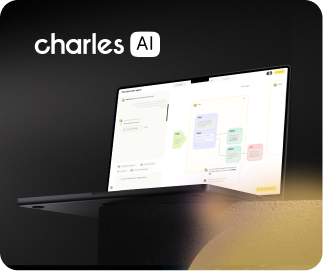
Discover how charlesAI empowers your business with advanced features and explore the complete product overview.
 See more
Powered by our AI agents, delivering personalization and scalability across your entire funnel.
Powered by our AI agents, delivering personalization and scalability across your entire funnel.
Discover how charlesAI empowers your business with advanced features and explore the complete product overview.
See more
Powered by our AI agents, delivering personalization and scalability across your entire funnel.
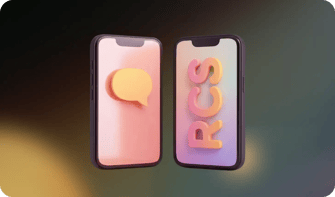

This article introduces RCS: what it is, what marketing capabilities it offers, and whether it's the right fit for your brand.
RCS stands for Rich Communication Services. It's a messaging protocol developed by the GSMA (the global mobile industry association) as the successor to SMS.
Think of it as SMS 2.0: same native messaging app, but with the features you'd expect from modern messaging platforms.
Where SMS is limited to 160 characters of plain text, RCS supports:
For users, RCS messages appear in the same messaging app they already use for texts.
For brands, it opens up a more engaging, app-like experience without requiring customers to download anything.
RCS development began in 2007, but early versions lacked features and interoperability between carriers. The breakthrough came in 2016 when the GSMA introduced the Universal Profile specification, which standardised RCS features across carriers and devices.
Google became the primary driver of RCS adoption, rolling it out through its Messages app on Android. By 2024, RCS was available on most Android devices globally.
The biggest shift came in September 2024 when Apple added RCS support to iOS 18.
This was a pivotal moment: RCS was no longer an Android-only channel. With both operating systems now supporting the protocol, RCS can reach virtually all smartphone users natively.
In March 2025, Apple and Google announced support for Universal Profile 3.0, which includes end-to-end encryption. This addressed one of the last remaining concerns about RCS security for business communication.
RCS marketing refers to using the RCS channel for promotional, transactional, and conversational communication with customers.
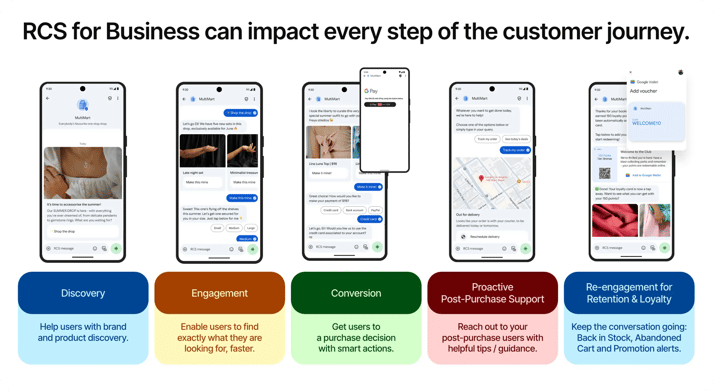
It combines the reach of SMS (native to the phone, no app download) with the engagement capabilities previously only available in messaging apps like WhatsApp.
For marketing teams, RCS offers capabilities that SMS simply can't match:
SMS has been the default for business messaging for decades.
It works on every phone, requires no internet, and has near-universal reach.
But it's also limited: plain text, no branding, no interactivity, and no way to know if a message was read.
RCS keeps the native messaging experience but removes many limitations.
For brands already using SMS, RCS isn't necessarily a replacement. Many use both: RCS for marketing and engagement campaigns where rich content drives results, with SMS as a fallback when RCS isn't available for a particular region, carrier, or device.
The key difference for marketers: RCS turns messaging from a broadcast channel into a conversation channel.
WhatsApp is the dominant messaging app in many markets, with over three billion users globally. It offers rich media, verified business profiles, and two-way conversations. So why consider RCS?
That said, WhatsApp has deeper market penetration in regions like Latin America, India, and parts of Europe. WhatsApp also offers click-to-message ads within Facebook and Instagram, which many brands don't fully leverage yet. Combined with AI agents, these ads can automate conversations, collect leads at low CPLs, and achieve higher conversion rates than static landing pages.
For many brands, RCS and WhatsApp complement each other as part of an omnichannel messaging strategy.
One of the most compelling aspects of RCS for acquisition-focused marketers is its integration with Google Ads.
There are two ways customers can enter an RCS chat from Google Search:
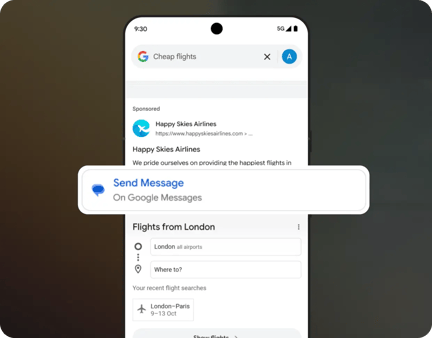
This model outperforms traditional landing pages for many use cases because it reduces friction. Customers get immediate, personalised responses instead of navigating a website. For brands, it means higher conversion rates and the ability to capture first-party data within the conversation.
RCS works across industries, but it delivers the highest impact where customer decisions benefit from visual content, personalisation, and real-time interaction.
In e-commerce and retail, brands use RCS to recover abandoned carts with product images and direct checkout buttons, send personalised product recommendations as swipeable carousels, announce flash sales with rich media, and keep customers informed with order confirmations and shipping updates.
Travel and hospitality companies send booking confirmations with interactive itineraries, upsell upgrades and experiences, provide real-time flight or reservation updates, and collect post-trip feedback.
Insurance and financial services use RCS for interactive product selectors, policy documents and renewal reminders, claims status updates with action buttons, and AI-guided conversations for lead qualification.
For lead generation, brands capture prospects from Google Search via RCS Message Ads, qualify them through automated conversation flows, book appointments or demos directly in chat, and hand off to sales when the lead is ready.
RCS isn't something you can set up on your own. Unlike email or web chat, it requires working with carriers and being verified by Google. Here's what's involved:
RCS is particularly well-suited for:
If you're already doing SMS marketing, RCS is a natural evolution.
If you're using WhatsApp, RCS can extend your reach to customers who prefer the native messaging app.
RCS is maturing quickly. With Apple and Android support, Google Ads integration, and growing carrier coverage across Europe, the channel is ready for brands that want to move beyond plain-text SMS.
If you're exploring RCS as part of your marketing mix, we can help you evaluate the opportunity, set up verified sender profiles, and build automated conversation flows that drive results.
charles is an AI-native platform for conversational marketing and commerce. We help consumer brands automate, personalise, and monetise customer conversations across WhatsApp or RCS. Official Meta Partner and verified Google RCS partner. Made in Berlin.