Powered by our AI agents, delivering personalization and scalability across your entire funnel.

Powered by our AI agents, delivering personalization and scalability across your entire funnel.
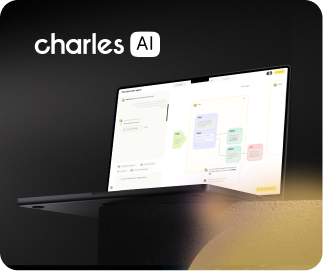
Discover how charlesAI empowers your business with advanced features and explore the complete product overview.
 See more
Powered by our AI agents, delivering personalization and scalability across your entire funnel.
Powered by our AI agents, delivering personalization and scalability across your entire funnel.
Discover how charlesAI empowers your business with advanced features and explore the complete product overview.
See more
Powered by our AI agents, delivering personalization and scalability across your entire funnel.

For years, SMS was the only native messaging option for brands. It worked - and still works - but it's limited: plain text, no branding, no interactivity. Meanwhile, messaging apps like WhatsApp raised the bar for what customers expect from brand communication.
RCS changes the equation.
With Apple adding RCS support in iOS 18 (September 2024), the channel now reaches both Android and iPhone users natively. For brands already using SMS, the question isn't whether RCS exists - it's whether it makes sense to add or switch.
This guide helps you answer that question.
SMS (Short Message Service) has been the standard for mobile text communication for over 30 years. It works on every mobile phone with a cellular connection - no internet required - making it one of the most reliable ways to reach customers.
Key characteristics of SMS:
For transactional messages like order confirmations, appointment reminders, or authentication codes, SMS remains a solid choice due to its reliability and reach.
RCS (Rich Communication Services) is a communication protocol designed to modernise mobile messaging. Unlike SMS, which is limited to plain text.
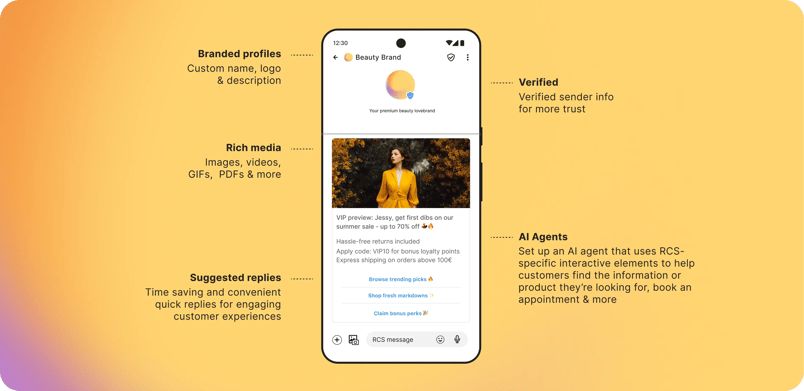
RCS supports:
For businesses, this means you can send product recommendations with images, let customers browse options via carousels, and drive actions with clickable buttons - all within the messaging experience your customers already use.
| Feature | SMS | RCS |
|---|---|---|
| Character limit | 160 characters | No character limits (long, detailed messages) |
| Media support | None (MMS required) | Images, videos, GIFs, audio files, documents |
| Interactive elements | No | Quick reply buttons, suggested actions, product carousels |
| Two-way conversations | Limited (text only) | Yes - users can reply, ask questions, and interact |
| AI agent integration | No | Yes - AI-powered chatbots for support, recommendations, lead qualification |
| Google Ads integration | No | Yes |
| Verified sender profile | No | Yes - branded business profile with logo & verification badge |
| Read receipts | No | Yes |
| Typing indicators | No | Yes |
| Cross-platform support | Universal | Android + iOS (since iOS 18), reaching nearly all smartphone users |
| Requires internet | No | Yes (Wi-Fi or mobile data) |
| App download required | No | No |
| Native app experience | Yes (SMS app) | Yes - works in the phone’s default messaging app |
| In-chat web view | No | Yes - browse products, view cart, and checkout without leaving chat (25%, 50%, 75%, or 100% overlay) |
| Fallback option | N/A | Automatically falls back to SMS if RCS isn’t available |
For years, RCS was limited to Android devices - a significant barrier for brands targeting audiences with high iPhone usage. That changed in September 2024 when Apple added RCS support with iOS 18.
This means RCS messages can now reach both Android and iPhone users natively, significantly expanding the channel's potential reach. In markets like Germany, RCS can now reach approximately 57 million devices - surpassing WhatsApp's 44 million users in the same market.
Key carriers in Germany (Deutsche Telekom, Vodafone, O2), the UK (Three, O2), and other European markets already support RCS for business messaging on both Android and iOS.
One of RCS's most compelling advantages for performance marketers is its native integration with Google Ads. Google is connecting its RCS push with the full power of Google Ad Manager - bringing conversational commerce directly into the search experience.
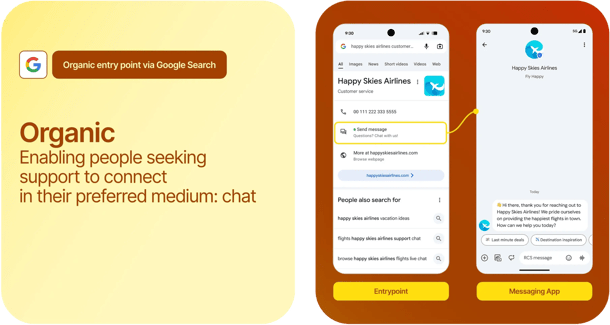
There are two ways customers can enter an RCS chat from Google Search:
1. Organically (for support) Customers searching for help or information can start a conversation with your brand directly from search results - no landing page, no contact form, just instant chat.
2. Via paid campaigns (for lead gen / conversion) Set up RCS Message Ads like any other Google Ads campaign. Instead of sending users to a static landing page, bring them directly into a conversation where they can explore products, get personalised recommendations, qualify themselves, or complete a purchase - all powered by AI.
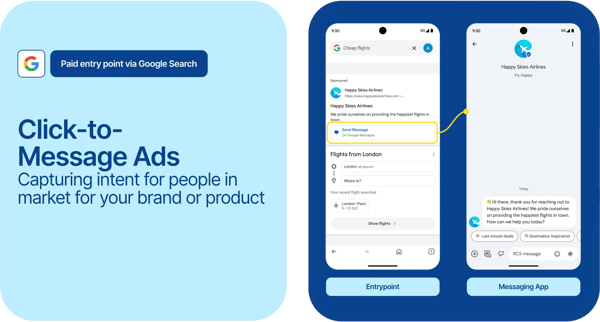
Why this outperforms traditional landing pages:
While SMS remains a reliable fallback, RCS offers significant advantages for brands focused on engagement, conversion, and customer experience:
With charles, you can set up automatic fallback from RCS to SMS, ensuring messages always reach your customers regardless of their device or carrier support.
RCS shines brightest in industries where customer decisions benefit from visual content, personalisation, and real-time interaction.
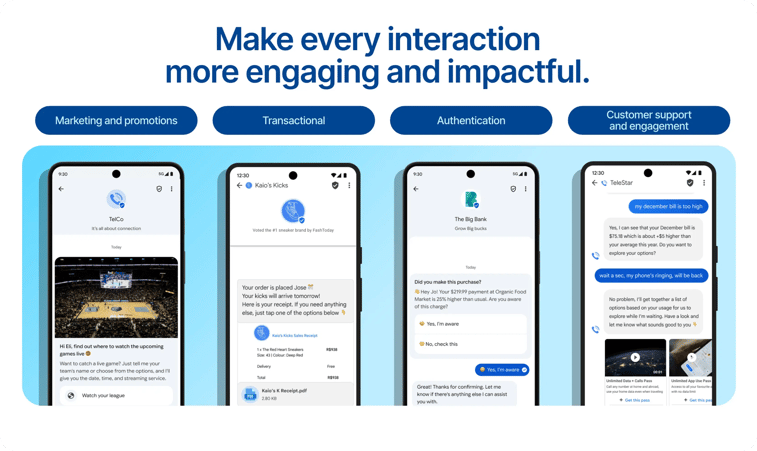
Here are some high-impact industry & use case examples:
RCS pricing varies depending on country, carrier, and message type. The pricing model is competitive, and some regions already offer MAU (monthly active user) pricing - especially when you factor in the higher engagement and conversion rates that rich, interactive messages can deliver.
The key consideration isn't just cost per message, but cost per conversion and overall business impact. RCS enables:
If you're considering RCS, here's what to look for in a provider:
Want to understand whether RCS makes sense for your business?
We'd be happy to walk you through the channel, discuss your specific use cases, and help you evaluate whether RCS - alongside SMS or WhatsApp - fits your customer communication strategy.
charles helps consumer brands automate, personalise, and monetise customer conversations across WhatsApp, RCS, and other messengers. As an official Meta Partner and Google Partner with years of experience in conversational commerce, we help brands turn messaging into a revenue channel.